
Carpooling is based on a simple principle: a driver shares their vehicle with one or more passengers for a given trip, in exchange for sharing costs. Finding the right trip at the right time requires more than just a simple search on an app. The difference between a smooth journey and a logistical nightmare often comes down to a few technical reflexes that most guides overlook.
Carpooling lanes: a regulatory constraint to know before you go
Before even looking for a trip, a regulatory point deserves attention. Since the end of 2025, carpooling lanes are monitored by automatic fines. Decree No. 2025-1269 of December 22, 2025, has included the use of these lanes in the list of infractions detected by approved control devices.
To use these lanes, the vehicle must carry at least two occupants. Electric or hydrogen vehicles, public transport, and taxis also have access, but the rules remain local and vary by route.
In case of an infraction, the fixed fine amounts to 135 euros. If the driver you are traveling with uses a carpooling lane while you are the only passenger, check that the vehicle meets the requirements. This detail can turn a quick trip into an unpleasant financial surprise.
Before searching for a carpool on Sport Cars, it is useful to check if your route includes carpooling lanes, especially on the suburban routes of major French cities.
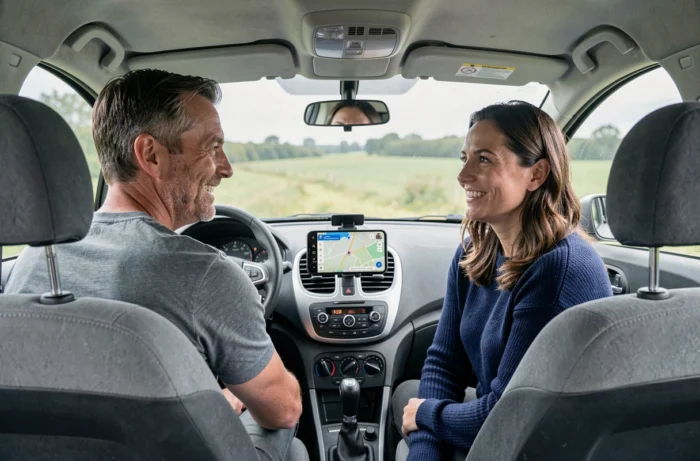
Carpooling search filters: going beyond simple city-to-city input
The majority of passengers enter a starting point and an endpoint, then look at the first result. This approach overlooks a good portion of available trips.
Expanding the geographical scope
Rather than entering an exact address, try starting points located a few kilometers away. A driver leaving from a neighboring town may offer a lower fare and have more seats available. On apps like BlaBlaCar or Karos, changing the search radius by a few kilometers can sometimes double the number of results.
Playing with schedules
A one-hour shift, by leaving earlier or later, opens access to trips that the initial search may have hidden. Trips published during the week for commuting carpooling follow recurring time slots. On weekends, departures are more scattered.
Three reflexes to refine a search:
- Test multiple spellings or neighborhood names for the pickup location, as platforms do not always manage geographical synonyms
- Activate publication alerts on the app used, to be notified as soon as a new trip matches your criteria
- Compare results on two different platforms, as drivers do not always publish on the same service
Carpooling insurance: what your auto policy covers (and does not cover)
One aspect rarely checked by passengers concerns insurance coverage. The driver’s auto insurance covers passengers under civil liability, provided that the carpooling remains a cost-sharing arrangement without profit.
The problem arises in two specific cases. The first: the driver uses a company vehicle. Recent decisions remind us that carpooling with a professional vehicle exposes the employee to disciplinary risk if the employer has not authorized it. The second: the contribution requested from passengers exceeds the strict sharing of costs (fuel, tolls, wear and tear). In this case, the activity legally shifts to paid transport, and standard insurance no longer covers anything.
Before getting into a vehicle, check that the requested price remains consistent with the distance. An abnormally low or high fare should raise a red flag. Serious platforms provide a guideline rate that serves as a reference.

Passenger profile and communication: the criteria that trigger acceptance
Drivers who receive multiple requests for the same trip make a selection. This selection rarely depends on price, as it is set in advance. It focuses on the passenger’s profile and the quality of the request.
A completed profile (photo, reviews, identity verification) significantly increases the acceptance rate. Regular drivers on BlaBlaCar or Karos check ratings before confirming a booking. A profile without a photo or reviews receives far fewer positive responses.
Communication before the trip plays an equally concrete role. Specifying the exact number of bags, confirming the meeting point, and signaling any potential delays can prevent last-minute cancellations. A message sent the day before departure to confirm your presence reassures the driver.
What to avoid in a request
- Requesting a significant detour without mentioning it in advance, as this generates immediate refusals
- Booking for multiple passengers without specifying it in the initial request
- Sending a request without any accompanying message, especially on long-distance trips
Motorcycle carpooling: an unknown but regulated usage
Sharing trips is not limited to cars. “Comoturage,” a term referring to carpooling among motorcyclists, falls within the legal definition of carpooling. Two motorcyclists making the same trip can share costs, provided that the contribution remains a cost-sharing arrangement without profit.
This sub-usage remains marginal but is gradually becoming structured. It mainly concerns commuting trips between motorcyclists using the same route. Insurance coverage follows the same rules as for carpooling by car: the driver’s civil liability covers the transported passenger.
Carpooling, whether by car or motorcycle, remains subject to a unique rule that conditions everything else: the passenger’s contribution must never exceed the actual cost of the shared trip. As long as this line is respected, the legal framework protects both parties.