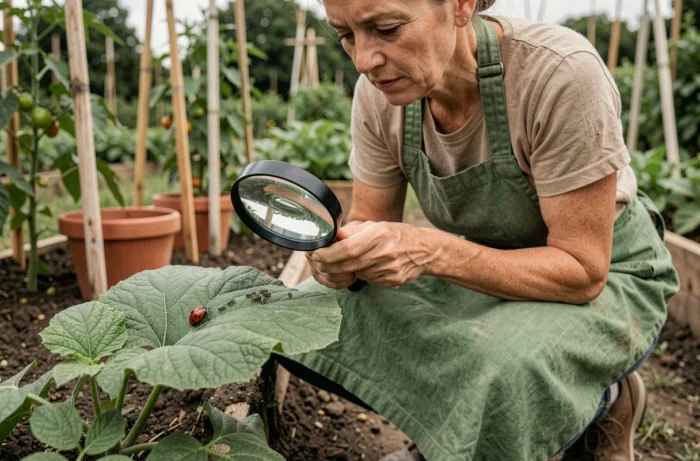
Distinguishing a harmful insect from a beneficial one in your garden relies less on the appearance of the animal than on what it is doing at the moment you observe it. Most guides provide lists of species categorized into two columns, allies on one side, pests on the other.
This reading grid poses a problem: the same family of insects can include both beneficial species and harmful ones, and an insect found on a damaged plant is not necessarily the one that caused the damage.
Why family identification is not enough in the garden
The common reflex is to recognize a silhouette (ladybug, wasp, caterpillar) and deduce a role from it. This approach often leads to frequent mistakes. Among ladybugs, for example, some species are formidable predators of aphids, while others attack cultivated plants.
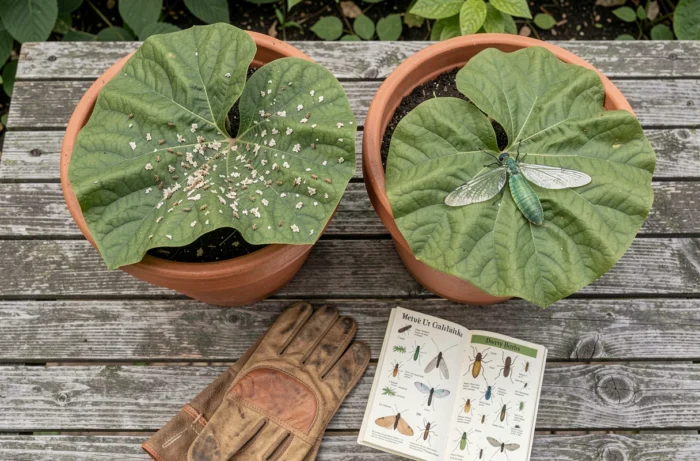
The usual visual clues (color, number of spots) do not always provide a clear answer. The species, life stage, and type of damage on the plant are three criteria that are more reliable than mere family affiliation. A gray, elongated lacewing larva looks more like a pest than the translucent green adult that gardeners associate with a beneficial insect.
This disconnect between appearance and function explains why so many gardeners mistakenly eliminate insects that naturally regulate pest populations. To delve deeper into these frequent confusions, you can read the article from La Fibre Câline which details several concrete cases.
Observe the damage before blaming the insect: diagnostic method
Marks on a leaf do not prove that the insect resting on it is responsible. A ground beetle found on a nibbled lettuce plant likely came to hunt the slugs that caused the holes, not to create them itself. Photographing the insect, the plant, and the damage together is the first useful step to avoid a false diagnosis.
Active damage or old traces
A perforated leaf may be several days old. If the edges of the holes are dry and brownish, the pest has likely left the plant. Confusing old damage with an ongoing attack leads to unnecessary treatments, to the detriment of already established beneficial insects.
Noting the date and location of each observation allows for tracking the actual evolution of an infestation. Two surveys a week apart provide more information than a single thorough inspection.
Clues that indicate a beneficial insect
Several signals suggest that an observed insect plays a beneficial role:
- It moves actively on the plant without feeding, visibly searching for prey (ladybug larvae, adult hoverflies)
- Aphids nearby appear swollen, with an exit hole: a sign that a parasitoid wasp has already laid eggs and that natural regulation is underway
- The insect is found on the ground, under dead leaves or stones, typical areas for nocturnal predators like ground beetles and rove beetles
- No fresh damage appears on the plant despite its repeated presence in the same spot
Aphids and predators: when to delay treatment in the garden
The presence of aphids on a rose bush or a bean plant often triggers an immediate reaction. Before intervening, a careful examination of the colony may reveal that natural regulation is already underway.
Ladybug, lacewing, or hoverfly larvae mixed with aphids indicate active predation. Each of these larvae consumes a large number of aphids during their development. Treating at this stage, even with a biological product, means eliminating predators along with pests, which promotes faster reinfestation.
The same logic applies to parasitized aphids. An aphid whose body has turned golden brown, rigid, with a small circular hole, has served as a host for a parasitoid wasp. A parasitized aphid is a sign that beneficial insects are at work, not a reason for treatment.
The difficulty lies in the tolerance threshold: at what density of aphids do the damages become truly problematic for the plant? This threshold varies depending on the plant species, its vigor, and the season. No universal rule applies, making regular observation more relevant than a treatment schedule.
Regulations on phytosanitary products and their impact on insect management
The French legal framework severely restricts the use of phytopharmaceutical products for amateur gardeners. This regulatory constraint is not just a limitation: it encourages the adoption of an observation logic that makes the distinction between harmful and beneficial insects all the more necessary.
When resorting to a broad-spectrum chemical insecticide is no longer an option, correctly identifying the insect before acting becomes a practical skill, not just a naturalist exercise. Misidentifying a beneficial insect can compromise the biological protection of a vegetable garden for an entire season.
Building a reliable observation record
For gardeners who wish to go beyond simple visual recognition, a structured record helps make better decisions:
- Photograph the insect with its immediate environment (leaf, stem, soil) rather than in an isolated close-up
- Record the date, approximate time, and weather conditions, as some beneficial insects are only active at certain times
- Return to the same spot five to seven days later to assess whether the damage is progressing or stabilizing
This type of monitoring often reveals that situations perceived as infestations resolve themselves within one to two weeks, thanks to the combined action of several beneficial species present in the soil and on the plants.
The distinction between harmful and beneficial insects is not a fixed label attached to each species. It depends on the moment, the place, and what the animal is actually doing when you observe it. A garden that tolerates a few aphids to allow predators to settle produces, over time, a more stable balance than a garden treated at every alert.