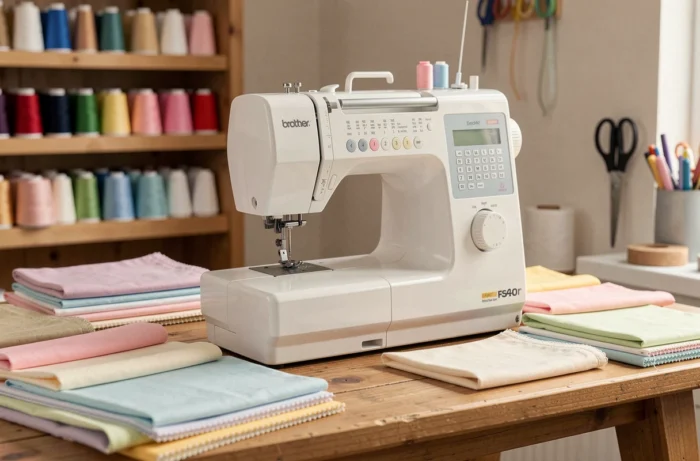
When you start sewing, the choice of machine directly affects the pleasure of sewing. A machine that is too complex discourages, while a machine that is too limited frustrates after a few months. The Brother FS40 positions itself between these two pitfalls: it is an accessible electronic machine, often cited as a reference for beginners and intermediate sewers.
Electronic feed of the Brother FS40: what it changes in daily use
Have you ever used an old mechanical machine where you had to turn a knob to select a stitch? On the Brother FS40, a small LCD screen replaces that knob. You press a button, the stitch number appears, and the machine automatically adjusts the width and length of the stitch.
In practical terms, this means fewer adjustment errors. A zigzag stitch that is too narrow or a straight stitch that is too long, these kinds of issues almost entirely disappear. The LCD screen displays the recommended presser foot for each stitch, which avoids having to consult the manual constantly.
The electronic feed also allows you to sew without a foot pedal, thanks to the built-in start/stop button. This detail may seem trivial, but for someone who has foot pain or lacks coordination at first, it is a real comfort. For everything you need to know about the Brother FS40, its settings, and the included accessories, a dedicated guide details each function.
Sewing stitches and versatility: Brother FS40 facing concrete projects
The machine offers 40 sewing stitches. This number looks impressive on paper, but in practice, most sewers regularly use about ten stitches, no more.
Stitches that really matter
- Straight stitch: the foundation of all assembly. On the FS40, it is consistent even at high speed, which reassures beginners.
- Zigzag stitch: used to overlock fabric edges when you don’t have an overlocker, or to sew stretchy materials like jersey.
- One-step automatic buttonhole: you place the button in the special foot, the machine calculates the size and sews the buttonhole without intervention. This is one of the real advantages of this model.
- Decorative stitches: useful for personalizing a project, but rarely a priority on a daily basis.
Why this choice of 40 stitches instead of 20 or 80? Brother aims for balance. With fewer stitches, some projects become impossible (automatic buttonholes, for example). With many more, the price increases without providing real benefits for domestic use.
Performance on different fabrics
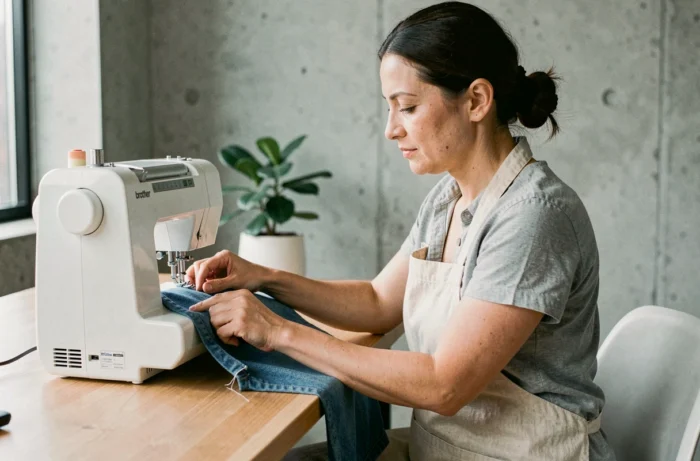
The FS40 easily handles cotton, linen, poplin, and most common clothing fabrics. On denim or thick fabric with multiple layers, it reaches its limits: the needle penetration slows down and the result may lack consistency.
This machine is not designed for sewing leather or heavy upholstery fabric. If your projects regularly include these materials, a more robust mechanical machine or a semi-professional model would be more suitable.
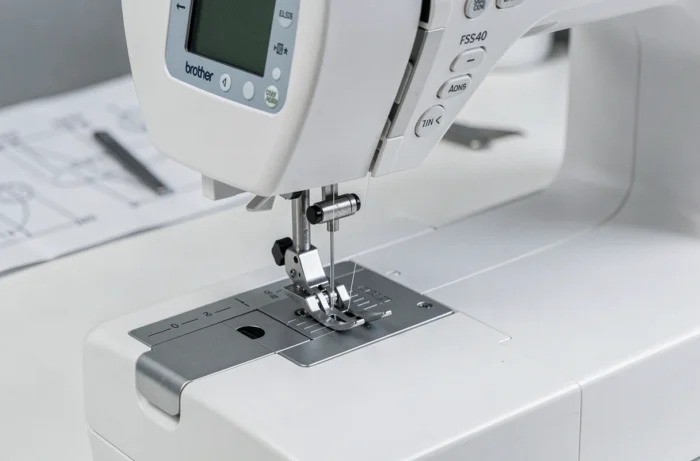
Brother FS40 or FS40S: understanding the difference between the two models
The confusion between the FS40 and the FS40S often comes up in discussions. The FS40S is a newer version, introduced as an evolution of the Brother range. It retains the same 40 sewing stitches and the same LCD screen.
The differences lie in finishing details and compliance. The FS40S bears the CE marking and identifies a market representative in the European Union, a point that is gaining importance with the tightening of European rules on machine traceability. Regulation (EU) 2023/1230 on machines, which will fully come into effect from 2027, imposes strengthened obligations on manufacturers and distributors.
For a purchase today, the FS40S represents the most up-to-date choice. If you find a classic FS40 at a reduced price (remaining stock), it remains functionally very close.
Reviews on the Brother FS40: the limits to know before buying
Online tests are mostly positive, and rightly so. The FS40 does well what it is designed for. Disappointments almost always come from expectations that are misaligned with the price range.
- The lighting in the sewing area is modest. In the evening or in a dimly lit room, an additional lamp becomes necessary.
- The operating noise is acceptable for an electronic machine in this range, but it increases significantly on thicker materials.
- The work area is compact, which complicates handling large pieces like curtains or a duvet.
These limits are not manufacturing defects. They reflect the positioning of the model: a machine for learning and everyday projects, not a semi-professional tool.
Thread and needle: two adjustments that change everything
Many problems attributed to the machine come from the thread or the needle. Low-quality thread breaks, forms loops, or clogs the mechanism. An unsuitable needle for the fabric causes skipped stitches.
Using branded thread (Gütermann, Mettler) and changing the needle for each new project, or every few hours of sewing, resolves most of the issues reported in negative reviews.
The Brother FS40 remains, after several years on the market, a reliable electronic machine in its price range. It is suitable for those who want to learn without being limited too quickly, while accepting that a compact machine will not replace a heavier model for intensive work. The simplest criterion for choice: if your projects revolve around clothing, accessories, and small alterations, this model covers the need widely.