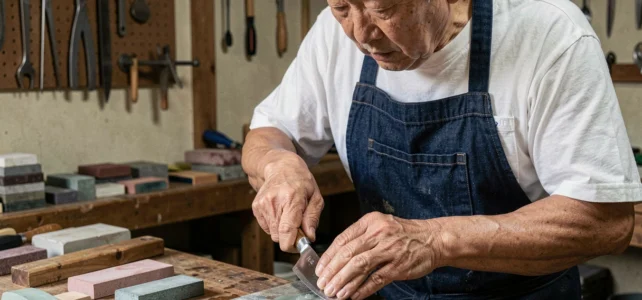
When searching for an authentic Japanese knife, the first instinct is often to compare brands. The real quality filter lies upstream: identifying the workshop that forges the blade, checking where and by whom it is made, and understanding what the production region implies for sharpness and durability.
A knife labeled “Japanese” may have been assembled elsewhere. A reputable brand may also offer very uneven ranges depending on the production line.
Made in Japan vs. Japanese Brand: A Distinction That Changes Everything
We often come across knives sold as “Japanese” when only the design or brand is. Checking the actual place of manufacture remains the first step to take before any purchase. Some specialized retailers clearly indicate this on their product sheets, while others remain vague.
To navigate, one can rely on documented cases. Tamahagane, for example, is made by the Kataoka factory in Niigata. Kasumi comes from the Sumikama Cutlery workshops in Seki. When a retailer mentions the exact manufacturer and its location, it is a reliable signal of transparency.
By exploring the world of Japanese knives on L’Art du Goût, one gains access to concrete leads to trace the supply chain back to the workshops. This traceability allows one to distinguish a knife forged in a historic cutlery from a rebranded industrial product.
Feedback varies on this point depending on the ranges of the same brand: a high-end line may be hand-forged in a traditional workshop, while the entry-level line from the same manufacturer comes from a semi-industrial chain. Asking for the specific production line, not just the brand, avoids many disappointments.
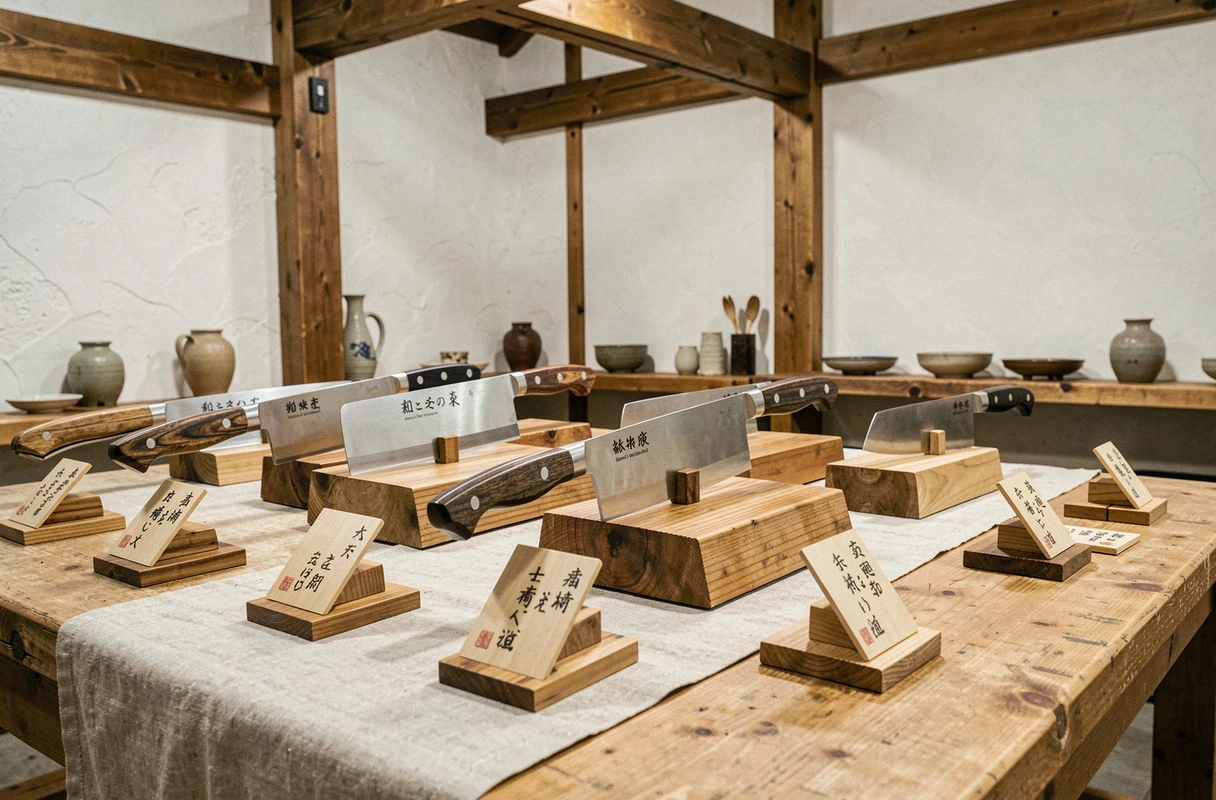
Steel and HRC Hardness: Reading Between the Lines of Product Sheets
The technical sheet of a Japanese knife almost always mentions the type of steel and sometimes the hardness in HRC. These data are not just for marketing: they directly condition the sharpness, ease of sharpening, and corrosion resistance.
Carbon Steels, Stainless Steels, and Damascus
A carbon steel (such as Aogami or Shirogami) offers a very fine edge but requires regular maintenance to avoid oxidation. A stainless steel (VG-10, AUS-10) is more forgiving for everyday use. Damascus, on the other hand, refers to a multi-layer forging technique that protects a hard core with softer layers.
- Carbon steel (Aogami, Shirogami): exceptional sharpness, sensitive to moisture, ideal for controlled professional use
- Stainless steel (VG-10, AUS-10): a good compromise between sharpness and maintenance, suitable for intensive domestic use
- Multi-layer Damascus blade: protects the hard core, provides a distinctive aesthetic, and adds some flexibility to the blade
The HRC hardness provides additional information. The higher the HRC, the longer the blade stays sharp, but the more fragile it becomes against lateral shocks. A knife around 60-63 HRC is suitable for precision cutting on a board. Below that, one gains robustness for tougher tasks.
What the Product Sheet Doesn’t Always Say
Some sellers omit the exact type of steel or simply state “Japanese steel.” The lack of precision about the steel is a warning sign. A serious artisan or retailer will always specify the steel grade, the number of layers for a Damascus, and the HRC hardness range.
Manufacturing Region and Know-How: Sakai, Seki, Tsubame-Sanjo
Japan has several cutlery hubs, each with technical specificities inherited from centuries of practice. Knowing the origin region of a knife helps anticipate its behavior in the kitchen.
Sakai, in Osaka Prefecture, is renowned for its hand-forged knives with a very marked division of labor: one blacksmith shapes the blade, another sharpens it, and a third assembles the handle. This specialization by trade explains the quality and high price of Sakai knives.
Seki, in Gifu Prefecture, concentrates a broader production that ranges from high-end craftsmanship to industrial. This is where Sumikama Cutlery manufactures the Kasumi. The city produces both exceptional blades and accessible series.
Tsubame-Sanjo, in Niigata Prefecture, has historically developed around metalworking. The Kataoka factory produces the Tamahagane there. Knives from this region often stand out for their careful polishing and hammered finishes (tsuchime) that reduce food sticking.
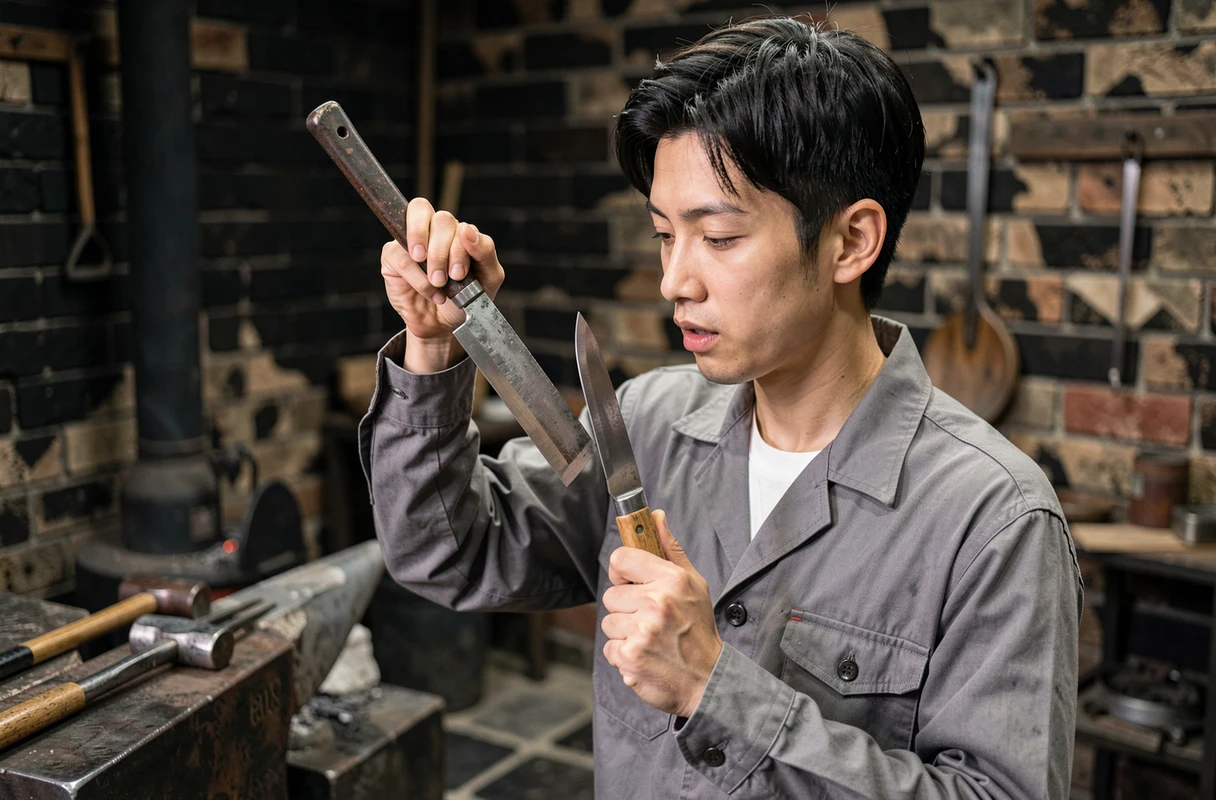
Concrete Criteria for Evaluating a Japanese Knife Artisan or Retailer
Beyond steel and region, some practical checks allow for quickly sorting reliable sources from approximate retailers.
- The product sheet names the blacksmith or workshop, not just the generic brand
- The type of steel, HRC hardness, and number of layers (if Damascus) are explicitly stated
- The retailer offers clear after-sales service: sharpening, handle repair, maintenance advice
- The photos show the blade from multiple angles, including the heel and tang (part inserted into the handle)
- The site distinguishes artisanal ranges from industrial ranges within the same brand
After-sales service deserves particular attention. A handmade Japanese knife is regularly sharpened on a stone, and the wooden handle may need replacement after several years. A retailer that includes these services in their offer demonstrates real product knowledge.
A good retailer talks about maintenance before talking about sales. This is a simple yet reliable indicator of their seriousness. The quality of a Japanese knife is not only measured at the time of purchase: it is verified over time, with each sharpening, with each clean cut that reminds us why we chose a forged blade over a mass-produced knife.