
An electric hedge trimmer with a cord remains the most rational choice for hedges located less than thirty meters from a power outlet. Its maintenance-free motor, constant torque, and moderate acquisition cost make it a tool we systematically recommend to gardeners who trim two to three times a season.
Spacing of the teeth and actual cutting diameter of the electric hedge trimmer
The spacing of the teeth determines the acceptable branch diameter much more than the motor power. A wide spacing accommodates thicker branches but allows fine shoots to slip through without being cut. Conversely, a narrow spacing produces a clean cut on young privet or boxwood shoots while getting stuck on lignified wood.
Further reading : How to Choose the Best Craftsmen for Your Authentic Japanese Knives
We observe that a tooth spacing between 24 and 28 mm covers the majority of residential hedges made up of thuja, laurel, or hornbeam. Beyond that, we enter the territory of thermal hedge trimmers or pole saws.
The blade length plays a complementary role. A short blade offers more maneuverability for topiary and geometric shapes, while a long blade reduces the number of passes on a linear hedge. To compare the technical characteristics of different models, the detailed sheets on taille-haie-electrique.com allow for quick cross-referencing of spacing, blade length, and power.
You may also like : How to Optimize CESU Rates for a Companion and Lighten Your Budget
Motor power and behavior under load on dense hedges
The power stated in watts does not directly translate to cutting capacity. Two motors displaying the same value can behave very differently depending on their design (inductive or carbon) and the transmission to the blade.

An inductive motor maintains its speed under load and heats less during prolonged passes through a dense laurel hedge. A carbon motor, which is less expensive, loses speed when resistance increases, leading to tearing rather than clean cuts.
The cutting speed under load matters more than the no-load power. Manufacturers rarely communicate this data. In practice, a model that slows down significantly in semi-hard wood indicates insufficient motor sizing for the targeted branch diameter.
Relationship between power and blade length
A long blade puts more strain on the motor because it engages more teeth simultaneously in the vegetation. Pairing a long blade with an entry-level motor generates excessive vibrations and premature wear of the drive mechanism.
We recommend checking that the motor torque remains consistent with the mounted blade. A model designed for a short blade gains nothing from receiving a longer blade, even if the mounting is physically possible.
Single action blade or double action: impact on cutting quality
The distinction between single action blade and double action blade is rarely explained in detail. On a single action blade, one row of teeth moves while the other remains fixed. The result: more vibrations transmitted to the arms and a higher noise level.
On a double action blade, both rows of teeth move in opposite directions. The vibrations largely cancel each other out, the cut is more even, and muscle fatigue decreases significantly during long sessions.
- Single action blade: lower cost, suitable for low hedges trimmed occasionally, marked vibrations beyond ten minutes of continuous use.
- Double action blade: cleaner cut, less vibration, preferred for long hedges or repeated passes in season.
- Diamond-toothed or anti-corrosion treated blades: extend the lifespan on resinous hedges where sap quickly clogs cutting surfaces.
A double action blade reduces fatigue and improves cutting sharpness. The additional cost is justified as soon as the hedge exceeds a few linear meters.
Blade maintenance and management of the power cord
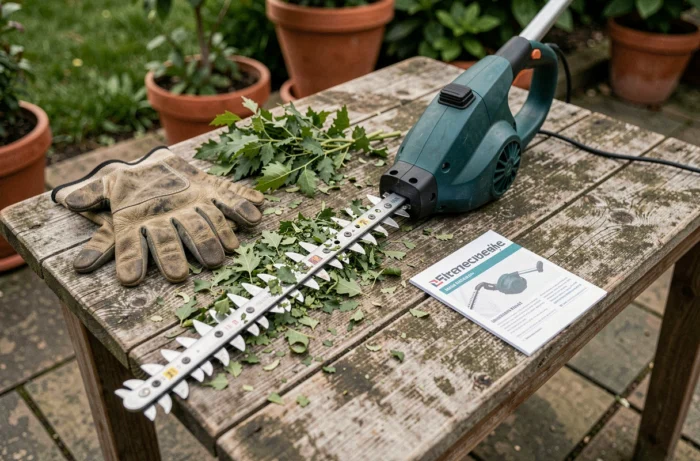
The longevity of an electric hedge trimmer depends as much on the maintenance of the blade as on the care given to the power cord. After each use, it is necessary to remove sap and plant residues with a cloth soaked in alcohol, then apply a suitable lubricant along the entire length of the blade.
A light sharpening with a flat file, following the original angle of each tooth, restores cutting capacity without altering the geometry. Never sharpen with a grinder, as this can overheat the steel and weaken the edge.
Safety related to the power cord
The cord is the structural weak point of the corded hedge trimmer. Passing the wire over the shoulder on the opposite side of the cut reduces the risk of accidental severing. Using an extension cord of appropriate gauge for the device’s power avoids voltage drops that strain the motor.
- Always plug the hedge trimmer into a socket protected by a residual current device.
- Inspect the cord sheath before each session: any cut, even superficial, requires replacement.
- Wrap the cord without tight bends after use to avoid internal breaks in the conductor.
European regulation on batteries and end-of-life for hedge trimmers
The EU battery regulation, which replaces the 2006 directive starting August 18, 2025, modifies manufacturers’ obligations regarding labeling and collection. For users of battery-powered hedge trimmers, this means more structured recycling channels and increased traceability of components.
Starting from February 18, 2027, portable batteries must be removable and replaceable by the end user in the EU. This point weighs on the choice between corded and cordless: a non-removable battery model purchased today could pose a compliance issue for resale or recycling in a few years.
Regardless of the type of power supply, an electric hedge trimmer at the end of its life should never go into regular household waste. Dedicated collection points for electrical and electronic equipment waste remain the only regulatory route.
The choice of a corded electric hedge trimmer boils down to three considerations: tooth spacing suitable for the actual diameter of the branches, double action blade for long hedges, and sufficient cord gauge to maintain motor speed. These three parameters determine cutting quality much more than the power displayed on the packaging.