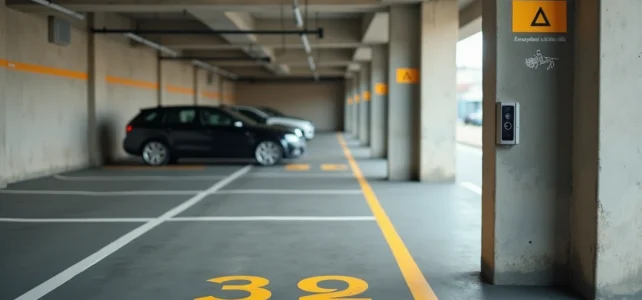
A co-owner who pays several dozen euros for on-street parking fees each month eventually starts to ask the question differently: how much does a parking space in a residence really cost, and when does the operation become profitable compared to street parking? The calculation is not limited to the displayed purchase price. Condominium fees, basement configuration, regulatory changes regarding paid parking in the city – several parameters alter the final bill well beyond the price per square meter.
Paid parking in the city: the hidden cost that changes the calculation
Since 2024, many French municipalities have been expanding paid parking on the street. Parking fees are increasing, and some cities are now adjusting the amount based on the weight of the vehicle. For a heavy vehicle like an SUV, the bill can rise quickly.
This pressure on surface parking creates a value premium for parking spaces in residences. This is evident on the ground: in neighborhoods where the parking fee has been raised, underground spaces are rented out more quickly, and sale prices follow suit.
Before comparing the rates of a parking space in a condominium, it is beneficial to quantify what street parking actually costs over twelve months. When comparing the price of a parking space in a residence to the annual total of parking fees and street subscriptions, the gap often narrows faster than one might think.

Location and configuration of the parking: what affects the purchase price
Two spaces located in the same city can show very different rates. The location within the municipality matters as much as the municipality itself.
Proximity to the center and pressure on parking
In dense city centers, parking spaces are rare and surface parking is saturated. The price directly reflects this pressure. In the suburbs, even in a large urban area, rates drop significantly because the availability of free on-street parking remains.
Local scarcity weighs more than the size of the city. A space in a dense residential neighborhood of a medium-sized city can be worth more than a space in the outskirts of a metropolis.
Type of location: closed box, underground space, outdoor parking
The physical configuration of the location significantly alters the price. A closed box costs significantly more than an open space in the basement, which itself exceeds the rate of an uncovered outdoor space. Feedback on this point varies by residence, but there is generally a gap of several thousand euros between a box and an open space in the same building.
Here are the configuration elements that directly influence the rate:
- The level of the basement: a space on the first basement level negotiates better than on the third, where maneuvering is more cumbersome and ventilation is sometimes insufficient
- The width of the space: narrow spaces designed for city cars lose value against increasingly wider vehicles
- The accessibility of the access ramp: steep slope, tight turn, or limited height discourage some buyers, especially those driving SUVs or vans
- The presence of a secure gate, proper lighting, and compliant ventilation, which reassure both the buyer and any potential future tenant
Fees and taxation: the items that are underestimated at purchase
The acquisition price is not enough to evaluate the true cost of a parking space in a condominium. Several recurring items add up.
Condominium fees related to parking
In a residence, parking spaces bear a share of fees: maintenance of common areas in the basement, lighting, mechanical ventilation, automatic gate. These fees represent a fixed cost that reduces net profitability. In some older residences with aging facilities, the bill can be surprising.
Before buying, one should request the fee statements for the last three years and the maintenance log of the parking. A replacement of the ventilation system or motorized door can amount to thousands of euros, shared among co-owners.
Taxation at purchase and rental
Notary fees on a parking space are proportionally higher than on a dwelling, as the sliding scales have less effect on small amounts. The weight of notary fees in the total price of a space is often underestimated.
If the goal is to rent the space, rental income is taxable under the property income regime (unfurnished rental) or the BIC regime (furnished rental, a rare case for a parking space). The choice of tax regime, micro or real, depends on the amount of deductible charges compared to the rent received.

Profitability of a parking space: balancing yield and constraints
Investing in a parking space is attractive because the entry ticket remains low compared to a dwelling. Management is simpler: no major rental degradation, no heavy works, and vacancy is managed without agency fees in most cases.
The gross yield of a parking space often exceeds that of an apartment, especially in medium-sized cities where the purchase price remains contained and rental demand is stable. However, since the monthly rent is modest in absolute terms, even a single month of vacancy or an unexpected charge weighs proportionally more.
A rarely discussed point: the gradual removal of surface parking spaces in city centers, combined with the expansion of low-emission zones, is reshaping demand. Spaces located near train stations or multimodal hubs are gaining attractiveness, while those far from public transport risk seeing their rental demand stagnate.
The rental contract for a parking space is less regulated than a residential lease. No minimum duration imposed, more flexible termination from both sides. This flexibility simplifies management, but it also means that a tenant can leave quickly.
Buying a parking space in a residence remains an accessible and clear investment, provided one does not rely solely on the displayed price. The real decision is made by adding up the recurring charges, taxation, and the opportunity cost of on-street parking, which continues to rise in French urban areas.