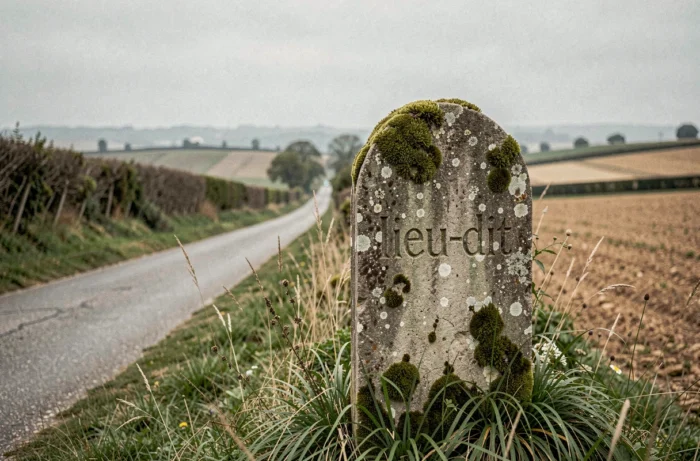
When browsing an IGN map or a road sign in the countryside, you come across names that seem interchangeable. A lieu-dit, a bourg, a village: these three terms refer to distinct realities, rooted in French rural history and the administrative functioning of municipalities.
The lieu-dit: a geographical marker, not a settlement
A lieu-dit primarily designates a named location on the cadastral map. It can refer to a field, a crossroads, a valley, or a small group of houses. The lieu-dit has no specific administrative status: it neither forms a municipality nor an electoral section.
Its name often comes from a feature of the landscape, an old owner, or an agricultural use. “La Fontaine,” “Les Music,” “Chez Bardon” are typical examples. Two or three buildings are enough, sometimes none.
Have you ever noticed that a postal address sometimes mentions a lieu-dit instead of a street name? This is common in rural areas, where street numbering does not always exist. The postman then relies on these names passed down from generation to generation.
To better understand the difference between lieu-dit, bourg, and village, it is essential to grasp that a lieu-dit may have no dwellings, while a village implies a minimum of communal life.
Bourg in France: the center that structures the rural municipality
The bourg occupies a special place in the organization of rural territories. Historically, this is where the market was held, an activity that required administrative authorization. The bourg concentrates the services that hamlets and lieux-dits lack: town hall, parish church, shops, school.
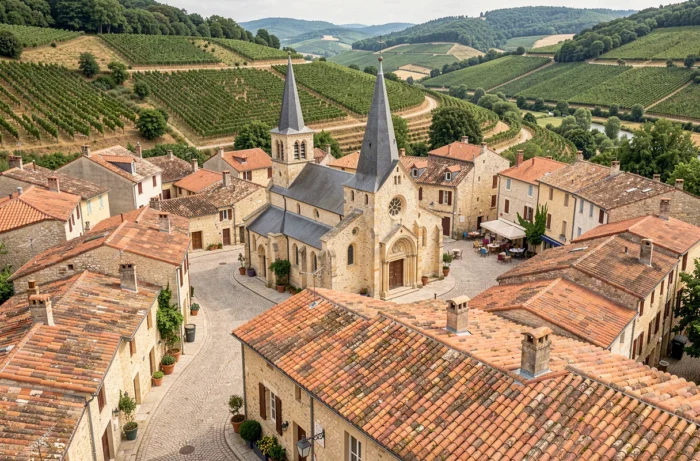
The word comes from a crossover between the Latin “burgus” (small fortification) and the Germanic “burg” (stronghold). This dual origin well reflects its function: a protected gathering point, situated between the village and the city.
In a rural municipality composed of several dispersed hamlets, the bourg designates the main core. When a resident says “I’m going down to the bourg,” they refer to the center where the bakery, pharmacy, or post office is located. This centrality role clearly distinguishes it from a simple village.
Bourg and municipality: two distinct concepts
A common confusion is to use “bourg” and “municipality” as synonyms. The municipality is the basic administrative unit in France, equipped with a municipal council and its own budget. The bourg is merely the geographical center of the municipality, its built heart. A single municipality can encompass a bourg, several hamlets, and numerous lieux-dits.
This overlap explains why the same space can fall under several simultaneous designations. The national program Villages d’avenir, for example, targets rural municipalities with fewer than 3,500 inhabitants. These municipalities can very well contain a central bourg surrounded by hamlets, without affecting their eligibility.
Village, hamlet, and settlement: the thresholds that make the difference
The village is defined by the presence of a community organized around shared facilities. Traditionally, the parish church distinguished the village from the hamlet, which did not have its own place of worship. The hamlet groups a few dwellings, without collective services.
Here are the criteria that help situate each level:
- The lieu-dit is a simple cadastral toponym, with or without habitation, without a collective function.
- The hamlet gathers a small number of houses but has neither a town hall, nor a church, nor a shop.
- The village has a church, sometimes a school or a café, and forms an identifiable community.
- The bourg adds to this a historical market and administrative services, serving as a hub for the surrounding area.
These distinctions are primarily practical. No legal text sets a threshold of inhabitants for transitioning from hamlet to village or from village to bourg. The General Code of Local Authorities recognizes only the municipality as the basic level.
Why these designations still matter in rural France
One might think these categories are obsolete. However, they remain very much alive in daily administrative and real estate matters. A property located “in the bourg” does not sell for the same price as a property isolated in a lieu-dit, as the proximity of services affects value.
Public policies themselves give new meaning to these terms. Since July 1, 2024, the France Ruralities Revitalization scheme has replaced the old rural revitalization zones. It targets rural territories considered fragile based on socio-economic criteria, not based on whether a place is called a bourg or a village.
The Villages d’avenir program illustrates another contemporary use: the word “village” serves as an operational label to assist municipalities in their development projects. “Village” becomes a tool of public action, not a legal status.
Reading a rural address without getting lost
When an address mentions a lieu-dit, it situates the property on the cadastral map. When it indicates “Le Bourg,” it points to the center of the municipality. These markers are useful for any real estate search or administrative procedure in rural areas.
- Check if the property is located in the bourg (access to shops and services) or in an outlying area (lieu-dit or isolated hamlet).
- Consult the cadastral map to identify the exact boundaries of a lieu-dit.
- Inquire about the municipality’s eligibility for rural revitalization schemes, which can influence local taxation.
Lieu-dit, bourg, village: three words that each tell a different relationship to the territory. The first names a place, the second organizes communal life, the third brings it to life daily. Keeping these distinctions in mind is to read the French landscape with a bit more precision.