The baby linen market in 2024 is structured around two axes: enhanced regulatory compliance and the choice of fibers whose technical properties meet specific uses. Bodysuits, muslins, and textile accessories are no longer differentiated solely by their patterns or colors, but by their traceability, certified composition, and wash durability.
GPSR and textile labeling: what changes concretely for baby linen
The European regulation on general product safety (GPSR), applicable since December 13, 2024, requires any operator selling textiles in the European Union to conduct a formal risk assessment and ensure complete traceability. Manufacturers, importers, and online sellers, including creators of handmade items, must clearly identify the responsible party in the EU on each product or its packaging.
In France, the obligation for textile composition remains distinct from the GPSR. The label on a bodysuit, pajamas, or muslin must mention the fibers used and their percentages, with the regulatory designations written in French. For online sales, this composition must be accessible before purchase, which means it must be displayed on the product page and not just on the physical label.
We observe that many small brands underestimate this dual requirement. The GPSR covers safety (mechanical, chemical, flammability risks), while composition labeling falls under consumer law. Ignoring either exposes one to market withdrawals or administrative sanctions.
Organic cotton, muslin, and bamboo: choosing between fibers for baby fabric
The choice of fabric remains the central technical criterion. Three fibers dominate the 2024 collections for body linen and muslins: organic cotton, cotton muslin, and bamboo viscose. Their properties are not interchangeable.
Cotton muslin, woven in a gauze weave, offers superior breathability compared to classic jerseys. Its airy structure makes it suitable for multifunctional muslins (swaddling, sunshade, lightweight blanket). However, its lower weight makes it less durable under repeated friction, limiting its use for bodysuits worn daily.
Bamboo viscose is appealing for its softness to the touch and its absorption qualities. However, we recommend checking the transformation process: conventional viscose uses solvents that can leave residues if industrial rinsing is insufficient. Parents looking for a cheap baby muslin on Excargot will find references in cotton and muslin with clearly displayed compositions.
Certified GOTS organic cotton covers the production chain, from pesticide-free cultivation to manufacturing. OEKO-TEX Standard 100, on the other hand, certifies the absence of harmful substances in the finished product without guaranteeing that the fiber is organic. Confusing these two labels remains a common mistake in commercial arguments.
- GOTS: organic fiber, social and environmental criteria throughout the chain, from field to finished product.
- OEKO-TEX Standard 100: testing of the finished product for harmful substances (heavy metals, formaldehyde, phthalates), with no requirement on the origin of the fiber.
- French regulatory composition: mandatory mention of fibers and percentages in French, including online.
Washing and caring for baby linen: weight, temperature, and fiber durability
Washing before first use is a technical recommendation, not just a hygiene tip. New textiles may contain residues of chemical finishes (softening agents, anti-wrinkle agents) applied in factories to improve the feel in stores. A first cycle at the maximum temperature indicated on the label helps eliminate most of these substances.
Durability in washing varies greatly depending on the weave. A compact cotton jersey retains its shape better after dozens of cycles than a gauze muslin, which tends to stretch. For bodysuits worn and washed daily, a sufficiently dense weight ensures better longevity.
Muslin cloths become softer with each wash due to the gradual softening of the cotton fibers. This is an advantage for direct skin contact, but one must accept a slight loss of structural integrity over time.
- Bodysuits in jersey: prefer medium-weight combed cotton for a good comfort/durability ratio.
- Muslin cloths: wash at moderate temperatures, air dry to limit shrinkage.
- Pajamas and sleeping bags: check for flammability resistance, a criterion covered by the child safety standards of the GPSR.
- Bamboo viscose: delicate washing recommended, as the fiber weakens more at high temperatures than cotton.
Bodysuits and muslins in 2024: what the collections convey in terms of design
The current trends in baby linen go beyond prints. The brands that stand out focus on design details: flat seams to reduce friction on the infant’s skin, cross-opening systems on bodysuits for easier dressing, and fitting adjusted to growth curves rather than arbitrary age ranges.
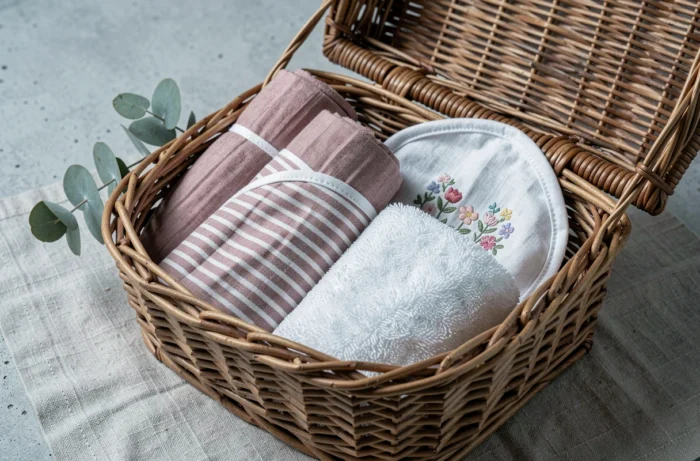
The multifunctional muslin remains the most versatile item in the layette. The same square of muslin serves as a bib, breastfeeding cover, emergency changing mat, or sunshade on the stroller. This versatility explains why muslin sets consistently rank among the most popular newborn gifts.
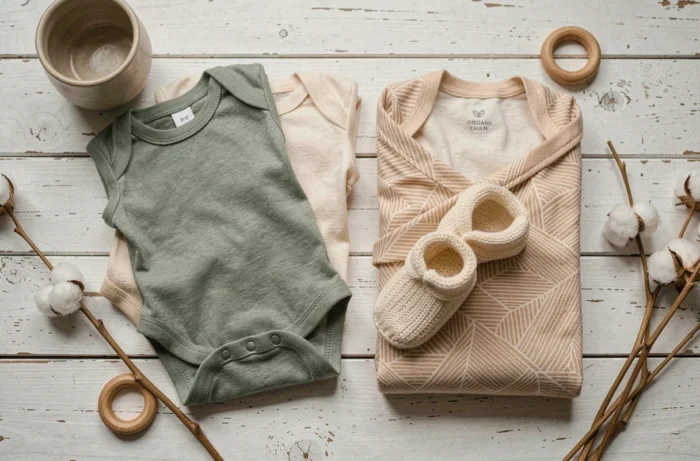
In terms of colors, the 2024 collections show a retreat from exclusively pastel palettes in favor of bolder shades (terracotta, sage green, deep blue) and geometric or botanical patterns. This aesthetic shift responds to parents’ demand for products that integrate into an adult domestic environment without visual disruption.
Traceability is becoming as strong a selling point as design or price. Parents buying online now check the product page for composition, place of manufacture, and certifications. A bodysuit without compliant labeling loses credibility, regardless of its design. This requirement, driven by both GPSR regulation and evolving consumer expectations, is redefining the standards of the baby textile market.