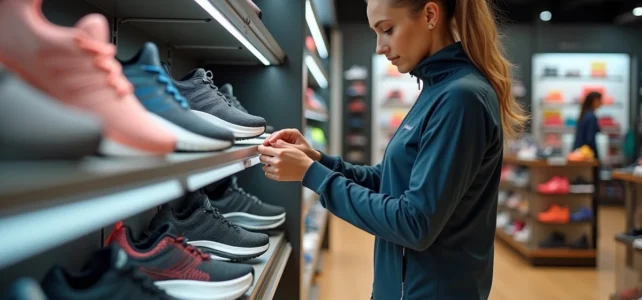
A poorly sized piece of equipment hinders progress long before a lack of training does. The choice of sports equipment is based on biomechanical and technical criteria that most general public guides gloss over in favor of aesthetic or budgetary considerations. Here, we will discuss the parameters that truly matter for transforming a purchase into measurable performance gains.
Sensors and connected devices: the invisible equipment that drives progress
The majority of sports equipment guides focus on physical gear (shoes, clothing, machines) without addressing the role of sensors in optimizing sessions. This is a hierarchical error. A power meter or a heart rate monitor better guides training than a change of shoes.
Heart rate variability, cumulative training load, power output at threshold: these metrics are useless without a reliable sensor to collect them. We recommend considering the choice of a connected device as the first step, not the last.
In running, a GPS watch with an embedded accelerometer allows tracking of cadence, vertical oscillation, and ground contact time. In cycling, the power meter remains the only tool that objectively quantifies intensity, regardless of wind, elevation, or fatigue. In weight training, some bar speed sensors measure concentric speed to adjust load in real-time.
The challenge is to choose a sensor compatible with your analysis ecosystem. Equipment that collects data without making it usable improves nothing. Check compatibility with ANT+ or Bluetooth Smart protocols, and the ability to export files to third-party analysis platforms.
To explore ranges of equipment and accessories suitable for different practices, a useful resource is: https://www.esprit-sport.com/, which covers both fitness and endurance sports.
Sports shoes: biomechanical criteria before marketing criteria
Drop, cushioning, and sole stiffness determine gait mechanics, not the brand or color. In running, the type of stride (heel strike, midfoot, forefoot) conditions the choice of drop. A runner who strikes midfoot on a high-drop model alters their kinetic chain and unnecessarily overloads the Achilles tendon.
For fitness and weight training, the logic reverses. One seeks a flat, incompressible sole with a drop close to zero. The cushioning that protects a runner on asphalt becomes a hindrance under a squat bar, as it creates lateral instability and reduces force transfer to the ground.
- Road running: drop between 4 and 8 mm for an intermediate runner, cushioning adapted to body weight and weekly volume
- Trail: sufficient depth of lugs for the intended terrain, reinforced upper for lateral protection, sole with puncture-proof plate on rocky ground
- Weight training and Olympic lifting: rigid sole, slightly elevated heel for Olympic movements, zero compression under load
- Indoor team sports: non-marking rubber sole, reinforced lateral support for direction changes
We often observe practitioners who buy the same shoe for running and lifting weights. This compromise degrades performance in both disciplines.
Home fitness and weight training equipment: balancing versatility and specificity
The home fitness market encourages the accumulation of devices. The question to ask before any purchase is not “which device is the best,” but “which device covers the most useful movements for my goal.”
A strength-oriented practitioner needs a rack, an Olympic bar, and calibrated weights. Investing in a treadmill or an elliptical bike at this stage is a budget diversion. Conversely, a cardiovascular or general fitness goal can be satisfied with a rowing machine or a bike, combined with a few kettlebells for strengthening.

The quality of cushioning and the ability to withstand intensive use distinguish a durable device from a disposable purchase. On a treadmill, the running surface, motor, and cushioning system directly affect longevity and joint comfort. An undersized motor for the user’s weight overheats and loses speed consistency.
- Check the maximum user weight stated and compare it to your actual weight, with a safety margin
- Prefer steel frames with welded finishes rather than bolted ones for weight training equipment
- Test the lateral stability of a bench or rack before purchase, especially for unilateral movements
Technical clothing: what the material changes concretely
The choice of sports clothing is not limited to breathability. Graduated compression improves venous return and reduces muscle oscillations during exertion, which has a measurable effect on fatigue perception during long sessions.
For outdoor practices, the three-layer system (base, insulation, protection) remains the standard. The base layer wicks away sweat, the middle layer insulates, and the outer layer protects against wind and rain. Choosing a textile unsuitable for any one of these layers compromises the entire system.
In the gym, a lightweight, quick-drying textile suffices for most activities. For weight training, a fitted t-shirt allows the coach or camera to check the movement trajectory, which is more useful than a loose garment that hides postural flaws.
The last often overlooked parameter remains the alignment between equipment and actual practice frequency. An athlete training twice a week does not have the same wear and recovery needs as a daily practitioner. Over-equipping a beginner means investing in equipment whose technical advantages will never be utilized. It is better to allocate this budget to a connected device that will guide progress, and then upgrade physical equipment when the training volume justifies it.