
On a sloping terrain with tight flowerbed edges, a battery-powered trimmer with insufficient power stops abruptly in the tall grasses. Too powerful, it is heavy and drains its battery in just a few minutes. Finding the right balance between voltage, capacity, and rotation speed avoids these two pitfalls. The ideal power for a battery-powered trimmer depends less on a single number than on the combination of three technical parameters, tailored to your actual usage.
Voltage, capacity, rotation speed: the three parameters that determine real power
We often refer to “power” as a single data point. In a battery model, this notion actually breaks down into three distinct values that interact with each other.
The battery voltage, expressed in volts, determines the motor’s torque. The higher the voltage, the more the line or blades can tackle dense vegetation without slowing down. Common models fall into two categories: around 18 V for light finishing work, and between 36 and 40 V for more demanding tasks.
Capacity, expressed in ampere-hours (Ah), determines autonomy. For a small garden, a battery of 2 to 4 Ah is more than sufficient. Beyond that, especially for extended sessions or larger areas, aiming for 4 Ah or more ensures you won’t run out of power midway. This criterion is at least as crucial as voltage, even though product specifications often downplay it.
Rotation speed, measured in revolutions per minute, reflects the effective cutting capacity. A motor that runs fast partially compensates for moderate voltage on fine grass. On tough vegetation, it is the combination of high voltage and fast rotation that makes the difference.
To choose the power of a battery-powered trimmer effectively, it’s better to consider these three values together rather than relying on a single marketing figure.
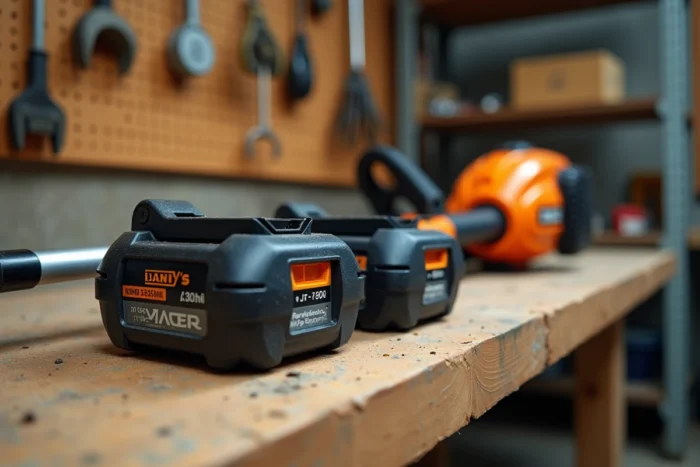
18 V or 36-40 V trimmer: which voltage for which terrain
Let’s start with a concrete situation. An urban garden with a regularly mowed lawn, a few trees, and a gravel path: an 18 V model with a 2 to 4 Ah battery meets this need easily. The device remains lightweight, maneuverable, and the battery charges quickly.
Change the context. A peripheral area with slopes, grass that grows between cuts, brambles along a fence. The 18 V reaches its limits: the line slows down, the motor overheats, the battery drains. We then switch to 36 V or 40 V.
User feedback on the 40 V
Users of the Makita 40 V XGT range report that the 40 V trimmer significantly outperforms older dual battery 18 V systems in raw performance. The gain is not limited to cutting power: the consistency of torque throughout the discharge changes the comfort of use. Feedback varies on the issue of weight, with some finding the extra weight acceptable, while others consider it a drawback during long sessions.
The 36-40 V is also justified when you already own a mower or hedge trimmer from the same platform. Buying a compatible trimmer avoids accumulating incompatible chargers and batteries.
Multi-tool platforms: shared battery changes the equation
Manufacturers have been promoting ecosystems for several years where a single battery powers all garden tools. A kit like the Voltcorp 40 V includes, for example, a hedge trimmer, a trimmer, and a push mower around a single battery format.
In practice, this changes the way power is chosen:
- First, select the platform (18 V, 36 V, 40 V, 56 V) based on the most demanding tool in the lineup, often the mower.
- The trimmer then fits into this ecosystem. Its voltage is dictated by the platform, not just by its own needs.
- Adjust the capacity of the battery dedicated to the trimmer: a lighter battery (2 Ah) for maneuverability, or the same high-capacity battery as the mower for continuous use without recharging.
Thinking in terms of a battery ecosystem rather than an isolated tool often saves a charger, a battery, and simplifies storage. Most major brands (EGO, Makita, Husqvarna, Einhell, Ryobi) offer this type of compatibility.
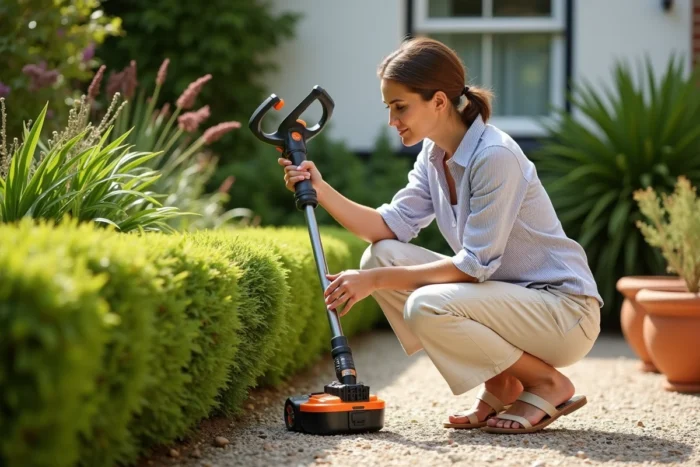
Line or plastic blades: a choice that interacts with power
The cutting head directly influences useful power. A standard nylon line is suitable for fine grasses and regular finishing work. Rotating plastic blades provide a cleaner cut on dry grasses or slightly thick weeds but put more strain on the motor.
On an 18 V model, using plastic blades can cause noticeable drops in speed in dense vegetation. On 36-40 V, the additional torque easily handles this demand.
Cutting diameter and head width
A wide cutting diameter (around 30 cm or more) speeds up work but requires more power to maintain the line speed across the entire width. If your terrain mainly requires narrow passages between flowerbeds, a compact cutting head with an 18 V motor is sufficient and gains in precision.
Conversely, to quickly clear large lengths of edges, a wide head paired with a 36-40 V motor is preferred. The compromise is always between work speed, weight, and autonomy.
- Fine grass, regular finishing, narrow passages: 18 V, nylon line, compact head.
- Tall grasses, light brambles, large edges: 36-40 V, thick line or blades, wide head.
- Mixed use with other tools of the same brand: prioritize the existing battery platform and adjust the Ah capacity.
The right battery-powered trimmer is not the one with the most impressive technical specifications. It is the one whose voltage, capacity, and cutting head match the terrain you actually work on, week after week. Starting by observing the vegetation to be cut and the duration of your sessions remains the most reliable way to size the power without overpaying or under-equipping.