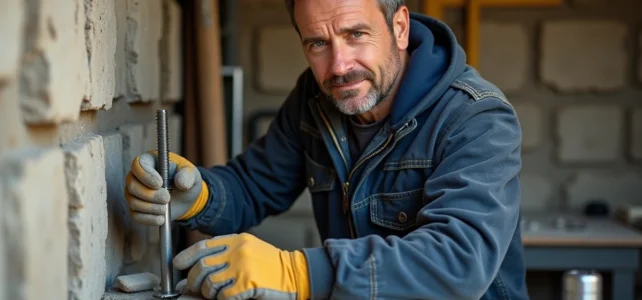
Chemical anchoring applied to wood and natural stone does not behave like in solid concrete. The resin, the substrate, and the threaded rod form a system whose performance depends on parameters that product datasheets rarely summarize: material porosity, residual moisture content, chemical compatibility between the mortar and the organic or mineral compounds of the substrate.
We detail here the technical points that condition the performance of a chemical anchor in these two families of materials.
Vinylester or epoxy resin: chemical compatibility depending on the substrate
On natural stone, the choice of the chemical base of the anchoring mortar directly affects the adhesion and durability of the fixing. Styrene-free vinylester resins offer a good compromise for most limestone and sandstone because they polymerize without generating excessive thermal stress in a porous material.
Pure epoxy resins develop superior mechanical resistance, but their rigidity poses problems on soft stones (tuff, Caen stone) where the differential expansion between the anchoring body and the substrate can cause superficial spalling. We recommend reserving epoxy for hard stones (granite, basalt, quartzite) whose modulus of elasticity is close to that of the cured resin.
In wood, the question changes radically. The chemical anchoring in wood and natural stone relies on a principle of mechanical anchoring through the penetration of the resin into the fibers, rather than a surface chemical bond as in concrete. The resin must impregnate the fibers without pushing them away, which excludes overly viscous or fast-setting formulations that would gel before migrating into the cellular network.
Drilling and preparing the hole in porous natural stone
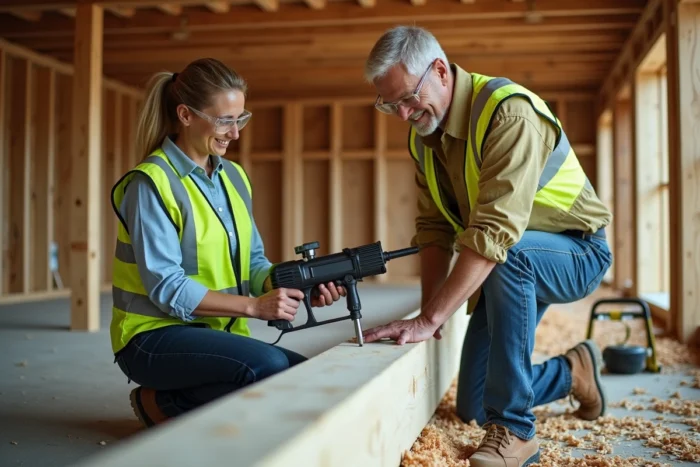
The diameter and cleanliness of the hole determine the performance of the anchoring as much as the choice of resin. On natural stone, drilling with a rotary hammer is to be avoided on friable materials. The percussion fragments the wall of the hole and creates a layer of compacted dust that prevents the resin from adhering to the healthy substrate.
Drilling in rotation only mode, with a diamond drill bit, preserves the integrity of the wall and limits the production of fines. After drilling, a two-pass blowing (blower then brush, then blower again) remains the minimum sequence to ensure direct resin-stone contact.
The anchoring depth deserves special attention on heterogeneous stones. A shell limestone or a sandstone with visible bedding may present internal cavities that absorb the resin without contributing to mechanical retention. We observe that on these substrates, it is necessary to increase the anchoring depth compared to the tables designed for concrete, and sometimes use an injection sieve to confine the mortar around the rod.
Chemical anchoring in solid wood and laminated wood: specific constraints
Wood is an anisotropic and hygroscopic material. These two properties complicate chemical anchoring in a concrete way.
- Anisotropy means that the pull-out resistance varies according to the orientation of the drilling relative to the grain of the wood. An anchoring perpendicular to the fibers subjects the wood to transverse shear, its weakest mode of failure. A parallel anchoring to the fibers multiplies the load-bearing capacity compared to a perpendicular anchoring, at the same depth.
- Hygroscopy causes dimensional variations of the wood around the sealed rod. If the resin is too rigid, the shrink-swell cycles create a gradual detachment at the interface. Hybrid mortars based on methacrylate, which are more flexible after polymerization, better absorb these movements.
- The moisture content of the wood at the time of installation must not exceed the threshold indicated by the resin manufacturer. Freshly delivered wood or wood exposed to rain may contain residual moisture that prevents the complete polymerization of the mortar, reducing the final retention of the anchoring.
On laminated wood, the presence of glue lines between the laminates introduces an additional discontinuity. The sealing resin and the structural glue of the laminated wood are not necessarily compatible. A pull-out test on a representative sample remains the most reliable method to validate the system before a series installation.
Stainless steel or galvanized steel threaded rods: which choice for treated wood
Autoclaved treated wood contains copper salts that, in the presence of moisture, accelerate the corrosion of galvanized steel. In this case, the A4 stainless steel threaded rod is the only durable option. The additional cost is marginal compared to the risk of failure of an anchoring whose rod corrodes beneath the surface, with no visible signs before failure.
Recent regulatory obligations for sealing resin applicators
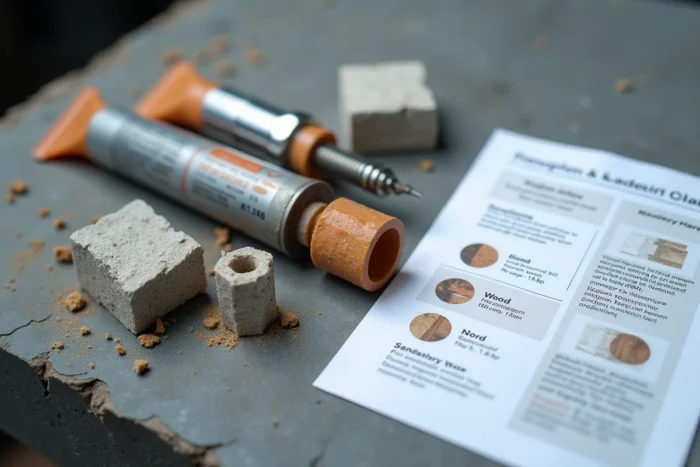
Since decree no. 2024-307 of April 4, 2024, any employer whose teams handle chemical sealing resins must maintain a nominative and updated list of workers exposed to hazardous chemical agents. This traceability obligation, effective since July 5, 2024, applies to routine installation sites and not just to situations of prolonged exposure.
For resins containing CMR (carcinogenic, mutagenic, reprotoxic) classified compounds, the requirements are strengthened: specific medical monitoring, limitation of exposure through organizational measures, and appropriate training in accordance with article R4412-38 of the Labor Code. These constraints modify the concrete organization of the sites, particularly the duration of intervention per operator and the ventilation of confined spaces.
These regulatory aspects do not change the mechanical performance of the anchoring, but they weigh on the actual cost of the service. A craftsman who complies with these obligations incorporates time for training, monitoring, and traceability into his quote, which partly explains the price differences observed between professionals for the same chemical fixing service on stone or wood.